
UV Curing Technology Glossary
The UV LED curing field is a rapidly developing and ever-changing industry. Below are frequently asked questions about technical terms. If you have any questions regarding terminology definitions, please contact Phoseek.
5/7/2026
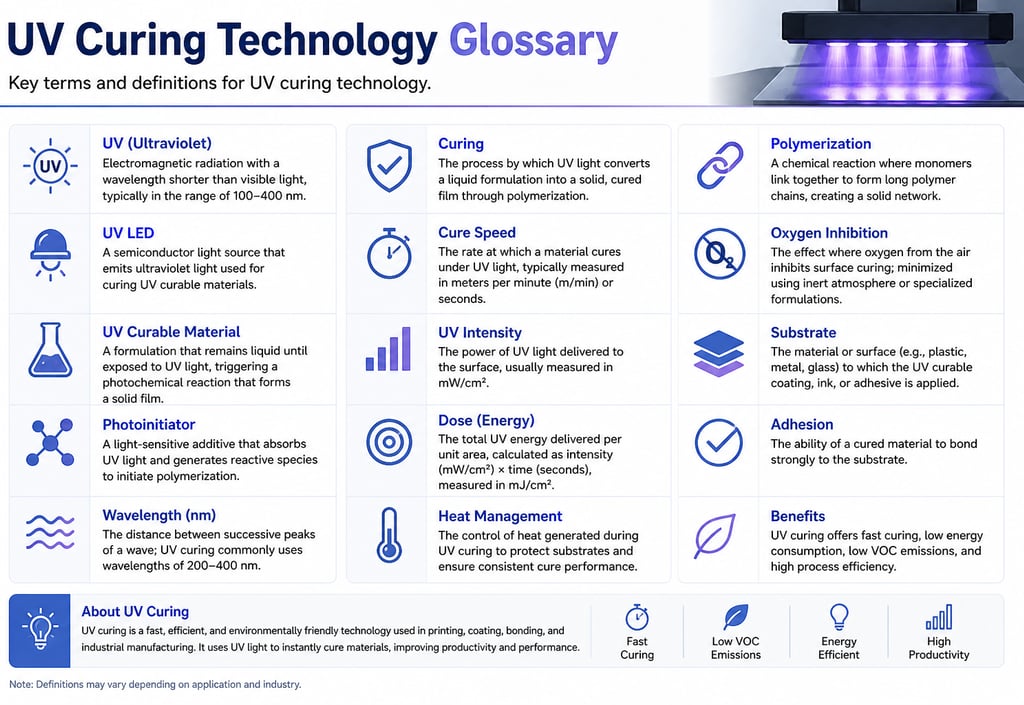
The UV LED curing field is a rapidly developing and ever-changing industry. Below are frequently asked questions about technical terms. If you have any questions regarding terminology definitions, please contact Phoseek.
Arc Lamp
(or arc lamp) is a general term for a class of lamps that emit light using an electric arc. Arc lamps are also called discharge lamps or arc discharge lamps. These lamps are usually named after the gas contained within the bulb, such as neon, argon, xenon, krypton, sodium, metal halide gases, and mercury. Common fluorescent lamps are actually a type of low-pressure mercury arc lamp.
Adhesive (used in UV printing inks)
Composed of monomers and prepolymers, usually acrylate compounds. Under the action of a photoinitiator, liquid acrylate compounds react under ultraviolet light to form a solid plastic film. Adhesives are synthetically produced.
Dosage:
Energy absorbed per unit mass.
On-Demand Inkjet Printheads (DoD)
Unlike continuous inkjet printheads, DoD printheads overcome surface tension instantaneously through controlled physical processes, ejecting clusters of ink droplets. Their ink supply pressure is insufficient to create a continuous ink flow. Printhead systems employing piezoelectric and thermal technologies operate in on-demand inkjet mode.
Inkjet
The printing process ejects ink onto the material surface through nozzles. Color output uses piezoelectric or thermal methods. Up to six colors can be used. A printing unit uses over one hundred nozzles. Print quality is comparable to four-color printing.
Irradiance
Irradiance refers to the radiant power reaching the surface from all forward angles. It is typically expressed in watts per square centimeter (W/cm²) or milliwatts per square centimeter (mW/cm²). The energy transferred to the substrate (expressed in joules per square centimeter (J/cm²) or millijoules per square centimeter (mJ/cm²)) depends on the linear velocity and irradiance.
LED UV Curing
Ultraviolet electronic light source that uses LEDs (light-emitting diodes) to dry inks, coatings, adhesives, and other UV-sensitive materials through polymerization rather than evaporation.
Nanometer (nm)
A metric unit of length, equal to one billionth of a meter. It is the most commonly used unit in semiconductor manufacturing technology and also the most commonly used unit to describe the wavelength of light; the wavelength range of visible light is between 400-700 nanometers.
Peak Irradiance
Irradiance refers to the peak value of the focused power directly below the luminaire. This is the maximum value of the irradiance curve, measured in W/cm² or mW/cm².
Photoinitiator
Additives used to cure printing inks and varnishes by absorbing ultraviolet light. Photoinitiators form reaction products (free radicals), which then crosslink with molecules in the adhesive.
Photometer
An instrument used to measure visible light, typically filtering or correcting the visible light to match the response of the human eye.
Piezoelectric On-Demand Inkjet (PIJ)
A type of inkjet design whose primary driving force is a piezoelectric material.
Polymerization
A chemical process that combines several monomers to form a polymer or polymer compound.
Inkjet Printing: The "needle punching" technique in inkjet printing allows the ink to partially solidify immediately after ejection, reducing dot gain and providing a sharper, more vibrant image on an inkjet printer.
Radiometer
A device that senses the amount of irradiance incident on its sensor element. Its structure may include a thermal detector or a photon detector. The instantaneous signal output is typically linearly proportional to the radiant flux and depends on the incident wavelength. This characteristic response to irradiance and wavelength is called responsivity.
Solvent-Based
Ink: Ink carried by an organic solvent (usually a volatile solvent).
Spectral Output
Refers to the relationship between the radiant output of a lamp and wavelength. It can be displayed in various ways, but the most common is a graph with output power (watts) on the ordinate and wavelength on the abscissa. The appearance of the graph can vary significantly depending on the wavelength resolution used.
Thermal Inkjet (TIJ)
Thermal inkjet printers have a heater installed at the bottom of the ink channel near the nozzle exit. Heating a liquid causes it to transform from a liquid to a gaseous state, resulting in volume expansion.
Total Ultraviolet Power
: The total energy of ultraviolet radiation emitted within the emission window region.
Ultraviolet Radiation
(UV) is a type of electromagnetic radiation with wavelengths shorter than visible light but longer than X-rays, ranging from 10 nanometers to 400 nanometers, and energies from 3 electron volts to 124 electron volts. It is called ultraviolet radiation because its spectrum contains electromagnetic waves with frequencies higher than the violet light perceived by humans.
UV
is an abbreviation for ultraviolet light.
UV Coating
refers to surface treatment methods that utilize ultraviolet radiation to cure or protect underlying materials from their harmful effects.
VUV, UVA, UVB, UVC
are names for ultraviolet wavelength ranges, originally used to differentiate the physiological effects of ultraviolet radiation and determine safe exposure limits. The generally accepted ranges are as follows:
Vacuum UV band: 100-200 nm
UVC: 200-280 nm
UVB: 280-315 nm
UVA: 315-400 nm
UVA is generally referred to as long-wavelength ultraviolet light, while UVC is considered short-wavelength ultraviolet light.
UV-cured inks
are inks that are cured by ultraviolet light irradiation. These inks can form hard and durable images and are less sensitive to the medium than solvent-based or water-based inks.
UV curing
refers to the polymerization of materials through ultraviolet light, rather than drying through solvent evaporation.
Ultraviolet lamps are lamps that emit ultraviolet light to cure ultraviolet-cured inks. Ultraviolet lamps can be arc lamps or ultraviolet LED lamps.
UV LEDs (ultraviolet light-emitting diodes) are electronic light sources whose electromagnetic radiation has a wavelength shorter than visible light but longer than X-rays.
UV printing:
Ink printing that is only visible under ultraviolet light.
UV printing ink systems suitable for energy-based UV curing
can be activated by UV radiation. They consist of pigments, liquid acrylates (binders, reactive diluents) or their prepolymers, and photoinitiators.
Wavelength
is the basic unit describing electromagnetic energy (including light). It is the distance between corresponding points in a propagating wave, equal to the speed of light divided by the equivalent oscillation frequency associated with the photon. UV wavelengths are currently measured in nanometers.
Address
Yabian Students' Surrounding Juki Industrial Park, Yabian Community, Shajing Street, Bao'an District, Shenzhen
Contacts
+86-13267162618 | WeChat (same number)
phoseek@uvphoseek.com